
Progesterone After A Hysterectomy - Why I Take It
If you've had a hysterectomy, you've probably been told you don't need progesterone. I was told exactly the same thing. And for six or seven years, I didn't take it. Then I did and honestly I wish I'd known more about progesterone years earlier.
Now, before we get into this, I want to make something really clear. I'm talking about my experience of taking progesterone after a hysterectomy. I am not a doctor and the standard guidance is that if you've had a total hysterectomy, you generally ‘don't need’ progesterone because there is no womb lining that needs protecting. According to current rresearch there are exceptions and individual circumstances, including things such as a subtotal hysterectomy or endometriosis, where the decision can be different. So please don't read this and go demanding progesterone from your GP because Rachel at Rayse told you to 😂
What I do want you to do is understand why I take it, what happened when I started it and why I think it's worth having a conversation with your doctor if you're struggling with symptoms.
My progesterone story
I had a hysterectomy and my ovaries removed, which put me straight into surgical menopause. For years, I was on oestrogen HRT without progesterone. And actually, I was okay.
I don't want to make out that I was desperately struggling every single day because I wasn't. I got on with life, I worked, I had my son, I ran Rayse alongside multiple other freelance work and I generally muddled my way through surgical menopause.
But there were periods where my sleep was awful. I'm talking waking up in the middle of the night, not being able to get back to sleep, waking up ridiculously early and lying there with my brain going at 100 miles an hour. I just accepted it and I thought, well, this is probably just my life now.
I'd get up, do something else, try to get back to sleep and carry on the next day. Looking back, I wish I'd known more about progesterone and the different ways HRT can affect people.
How did I end up taking progesterone?
Fast forward about six or seven years after my hysterectomy and I was struggling again. I was exhausted. I couldn't get through the day without wanting a nap. My concentration was rubbish and I couldn't focus on work properly.
I actually went into my appointment thinking I needed testosterone. I'd been learning loads about testosterone, talking to women who were taking it and hearing about how much it had helped them, so I thought that's what's missing for me.
I explained what was happening and my GP suggested we try progesterone first, alongside changing my oestrogen. So that's what I did and the effect on my sleep was almost immediate. I took the first capsule and it honestly felt like I'd taken a sleeping tablet. A very gentle sleeping tablet, but still. 😂 Which is much better from the ones I was shipping over from USA to get me through the night, but that’s another story!
I was SO sleepy. I remember thinking, ohhhh... is this what sleep is supposed to feel like? My sleep massively improved.
The concentration and daytime energy weren't magically fixed overnight, which is important because I later went on to try testosterone as well. But the improvement in my sleep was something I couldn't ignore. And I genuinely couldn't believe I'd gone six or seven years without progesterone even being part of the conversation. To be honest, I am annoyed about it which is whyI feel so passionate about sharing my story. I dont want you to suffer.
Side effects of progesterone
When I first started progesterone I had some side effects.
For me, these included:
Really sore nipples
Bloating
Feeling more emotional
Very, very sleepy
The sleepy part was actually quite extreme for me at first. I take 100mg of micronised progesterone and I take it at night because it makes me tired. I usually take it around 9pm because if I take it too early I'm basically ready for bed at 8pm.
And there have been mornings where I've woken up feeling a bit groggy. I wouldn't drive after taking it when I feel like that, and I'd definitely say you need to see how it affects you personally before doing anything that requires you to be alert. But for me, the sleep benefit has been worth it.
Some people really can not tolerate it, and this Instagram post from Doctor Hannah Olivia Davies really sums it up nicely - https://www.instagram.com/p/DdcNKLejuxw/?img_index=1
And then I accidentally stopped taking it
This was entirely my own fault. I forgot to reorder it. Then I forgot to pick it up from the pharmacy and suddenly I'd had about a two-week break. I was actually sleeping okay and felt like I didn't really need it. Who am I to defy medicine? 😂
So I started taking it again. And guess what? The bloody side effects came back: The sore nipples. The bloating. The slightly more emotional feeling.
The bloating was particularly annoying because the first time around it lasted for weeks. I would say it took around eight weeks for me to feel properly settled the first time. This time, thankfully, it settled much quicker. Which taught me something very useful:
If you're taking HRT and you stop and start it, don't assume your body will just pick up where it left off.

Me asleep after I take my progesterone… 🤣
So why are women without a womb usually told they don't need progesterone?
This is where it gets interesting.
The main reason progesterone is prescribed alongside oestrogen HRT is to protect the lining of the womb from the effects of oestrogen. If you've had a total hysterectomy and therefore don't have a womb, there is no endometrial lining to protect, so NICE guidance says progesterone is generally not needed.
But this doesnt actually make sense to me. I had serious insomnia, I started progestereone and honestly the problem was fixed. Almost right away! So the hormone has to be doing something other than protecting the womb, I dont have one, yet I still benefit from progesterone.
But your individual circumstances still matter. Because everyone is different. For example, the guidance can be different if you've had a subtotal hysterectomy where some endometrial tissue remains, or if you've had a hysterectomy because of endometriosis. The British Menopause Society recommends considering continuous combined HRT in women who have had a hysterectomy for severe endometriosis because of concerns about reactivation of residual disease.
So I don't think the conversation should simply be:
“You don't have a womb, therefore progesterone is completely irrelevant.”
I think it should be:
“You don't have a womb, so you don't need progesterone for womb protection. But let's look at your symptoms, your medical history and whether there are other reasons it might be appropriate for you.”
And that is a very different conversation.

What if your doctor says no?
This is where I think advocating for yourself matters. This is why I have built this community. We learn from each otheres experiences and can go in to our doctors apointments with a better understanding of what we need to ask for.
I've had a hysterectomy for seven years and, in all that time, there has been one doctor who suggested progesterone to me. One!!
And I only ended up trying it because I went to my GP with my symptoms and she suggested it as part of the plan. So if you're struggling with things like poor sleep, anxiety or other symptoms, don't just assume that because you've had a hysterectomy there is nothing else to discuss.
Go in with your symptoms. Track them. This is really important.
I actually think this is one of the most useful things you can do before a menopause appointment. For four weeks, write down:
How you're sleeping
How often you're waking up
Your anxiety levels
Your mood
Your energy
Your concentration
Any other symptoms you're struggling with
It doesn't need to be complicated. You can literally write it in your phone notes app.
Then take that information with you. You're not going in saying “I saw this on TikTok and I want progesterone.”
You're going in saying: “This is what has been happening to me for the last four weeks. Can we talk about what might be causing it and what my options are?”
And if you aren't happy with the appointment, you can ask to see another GP. You can also ask whether there is someone at your practice with additional menopause experience.
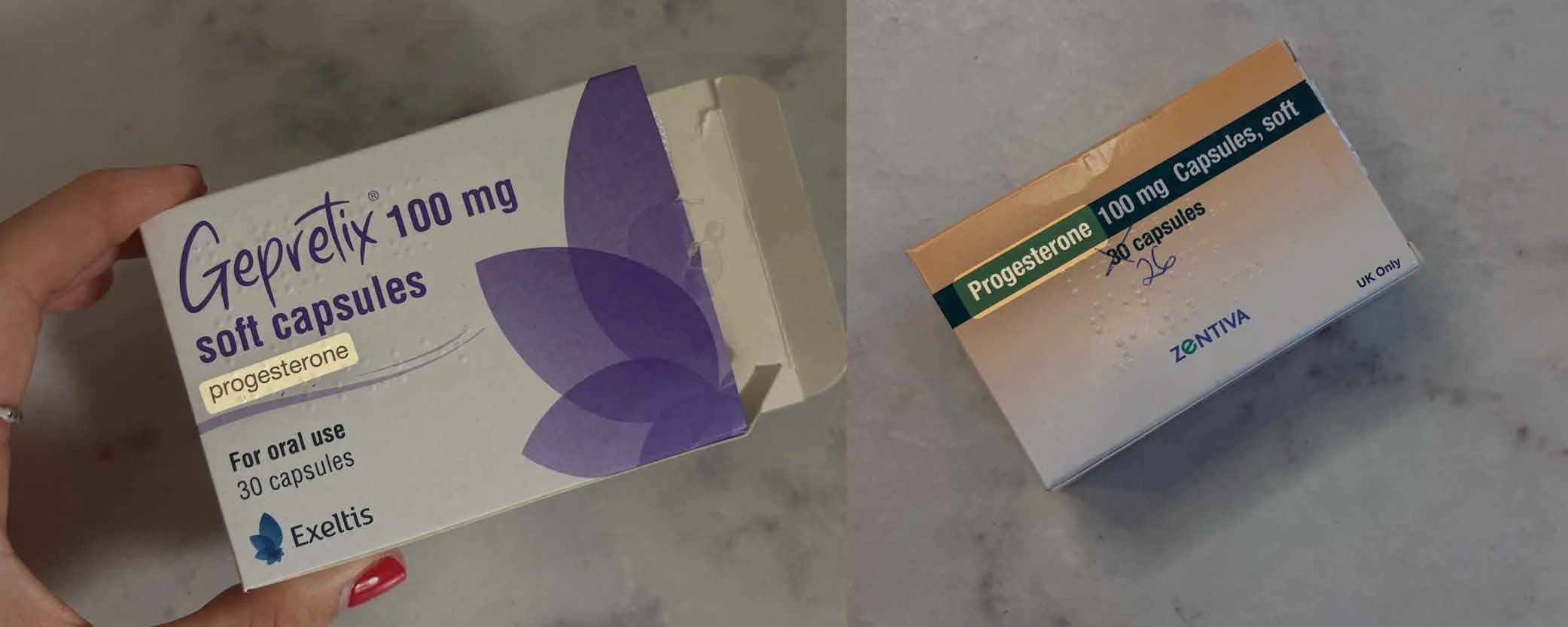
The different types of progesterone I take. They tend to be the same ingredients but different brands. Some people find they struggle with certain brands. I seem to be okay switching.
Ask questions
One thing I always tell women is: ask why.
If your doctor says progesterone isn't appropriate for you, ask:
“Can you explain why?”
“Are there any circumstances where you would consider it?”
“What are the potential risks and benefits for me personally?”
“Is there another treatment that might help with the symptoms I'm experiencing?”
You're allowed to ask questions and if you don't understand the answer, ask them to explain it again.
What I've learnt from the Rayse community
This is another reason I feel so strongly about talking about this. I've had women in the Rayse community tell me they've gone to their GP with awful sleep, anxiety and other symptoms after a hysterectomy and been shut down immediately because they don't have a womb.
One woman shared a message after being told no when she asked whether progesterone could be an option for her. She had had a hysterectomy and both ovaries removed, and after increasing her oestrogen she was experiencing nausea, restlessness, health anxiety and terrible sleep. Her GP told her no because she didn't have a womb and she came away feeling completely unheard.
And that is the bit that really bothers me. Not that every woman should be given progesterone but that women should be able to have an informed conversation about their options.
What about endometriosis?
This is another important one. If you've had a hysterectomy because of endometriosis, make sure you tell your menopause specialist or GP about your history. Endometriosis can persist outside the womb, and the British Menopause Society advises that continuous combined HRT should be considered after hysterectomy for severe endometriosis because of the possibility of residual disease.
So again, this isn't a simple “hysterectomy = oestrogen only” conversation for everyone.

So, do I think every woman who has had a hysterectomy should take progesterone?
No. And I actually think that's important to say. I take progesterone because I feel like it has made a huge difference to me, particularly my sleep.
That doesn't mean you will have the same experience. Some people don't get the same sleepy feeling I do. Some people don't tolerate it. Some people don't need it. And some people may have medical reasons why a particular HRT regimen isn't appropriate for them.
HRT should be individualised, and your treatment should be reviewed based on your symptoms, medical history and the benefits and risks for you.
What I do think is important is that women understand that there is more than one conversation to have about menopause after a hysterectomy.
Resources
I’m a big believer in going into an appointment with something credible in your hand rather than trying to explain everything from memory while your brain has completely left the building. Here are some resources I’d recommend having a look at before your appointment. You can read them yourself, print them out or take them up on your phone and use them to help start the conversation.
Don’t forget your symptoms!
📖 British Menopause Society
This resource states: “For women undergoing surgical menopause due to endometriosis 9: 1. Continued combined estrogen/progestogen HRT is advised following hysterectomy in women who have widespread endometriosis to reduce the risk of stimulation and malignant transformation of endometrial deposits.”
🩺 Doctor’s Opinions
This reel is from Doctor Louise Newson, which I think sums it up all very well and is worth watching [watch here]
This Youtube video is a good watch from Dr Susan Hardwick-Smith [watch here]
My own TikTok playlist on progesterone is worth binge watching too as you can see my experience [watch here]
I’ve also rounded up some Doctors opinions in this TikTok [watch here]
If you’re told no…
And if you're told no, it's completely reasonable to ask why. You could ask: (write these down!)
“Can you explain why you don't think progesterone is appropriate for me?”
“Are there any circumstances where you would consider a trial?”
“Could my individual history change the type of HRT that's appropriate for me?”
“Would you recommend that I speak to a menopause specialist?”
You're not walking into the appointment demanding a particular treatment. You're asking questions and making sure you understand the reasoning behind the treatment you're being offered.
And yes, I'm still taking it
I'm still on 100mg micronised progesterone, which I have learnt over the years is actually a pretty low dose, but it seems to work for me. I've now been taking it for well over a year and I still love what it has done for my sleep.
I've also since added testosterone, because the progesterone didn't magically fix everything. I still had issues with concentration, motivation and daytime energy, which is why my HRT has evolved over time. That's probably the biggest thing I've learnt from menopause: There isn't always one magic hormone that fixes everything. You can learn more about my experience with testosterone here.
Sometimes it's about working out what is actually going on, trying something, giving it time, reviewing it and changing things if you need to. and sometimes that means advocating for yourself.
So if you've had a hysterectomy and someone has simply said “you don't need progesterone because you don't have a womb”, I don't want you to read this and think “Right, Rachel says my doctor is wrong.”
Instead, I want you to think: “Okay, what are my options?”
Because that's the question I wish I'd known to ask six years earlier. And if you're taking progesterone after a hysterectomy, I'd genuinely love to know how you've found it because one of the best things about Rayse is that women can share these experiences with each other.
And sometimes hearing “me too” is exactly what you need.
Join over 250 women going through surgical menopause here: https://www.raysecommunity.com/why-join
Rache xx
This article is based on my personal experience and conversations within the Rayse community. It isn't medical advice and doesn't mean progesterone is appropriate for everyone after a hysterectomy. Speak to your GP or menopause specialist about your individual circumstances, particularly if your hysterectomy was subtotal or related to endometriosis or another medical condition.
